On building a transformative dialogue
Ólafur Elíasson’s Your unexpected encounter, which opened at Istanbul Modern in June 2024, is the artist’s first solo exhibition in Turkey and reflects his art practice over three decades. The exhibition offers a participatory environment in which to interact with space, form, light, and color while raising awareness of global concerns, such as sustainability and climate change.
Ólafur Elíasson was born in 1967 in Copenhagen. He lived in Iceland and Denmark before he moved to Berlin and founded the Studio Olafur Eliasson in 1995. The artist works with a large team from various disciplines, including archivists, architects, programmers, scientists, art historians, and engineers. Using sculptures, photography, painting, film, and installations, Eliasson’s work questions the nature of reality and creates intense atmospheres for shared artistic exploration.
Curated by Öykü Özsoy Sağnak, Nilay Dursun, and Ümit Mesci, the exhibition opened on June 7 at Istanbul Modern Museum and will be open to visitors until February 9, 2025.
Your unexpected encounter is an embodied experience shaped by viewers’ perception, location, and movement, which continuously transitions the artwork. The indisputable connection between people’s behavior and architectural morphology adds a bodily dimension to how we perceive objects and invites us to think about our relationship within the living space. Instead of having the constructed image of seeing an artwork, Eliasson wants us to interact with every piece from various angles and acknowledge the value of being entirely present in an environment.
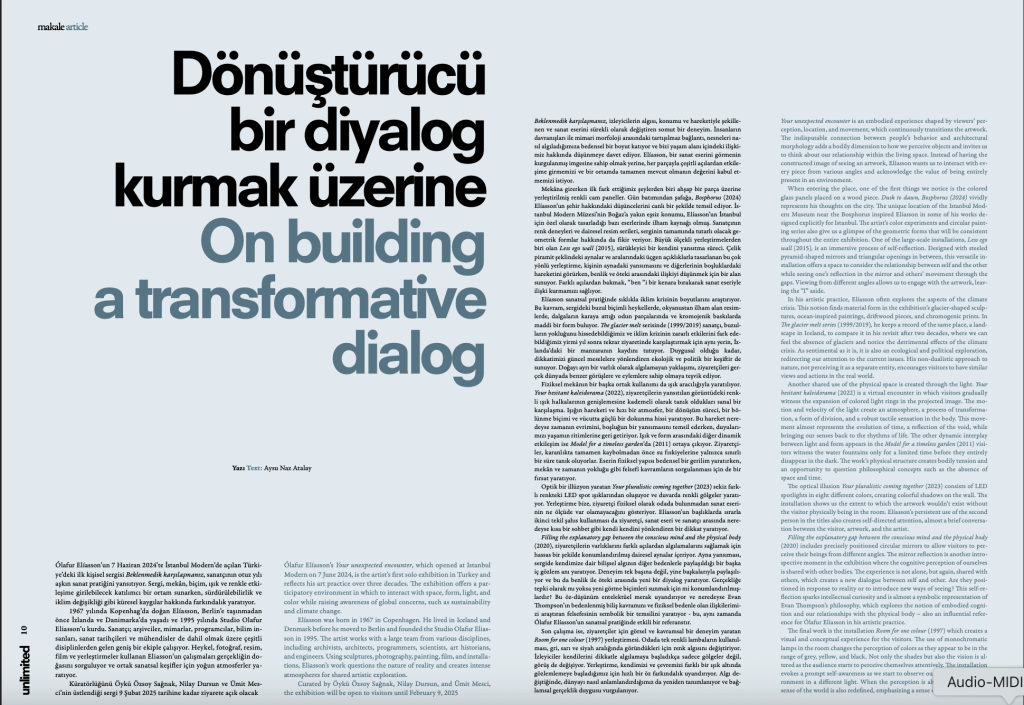
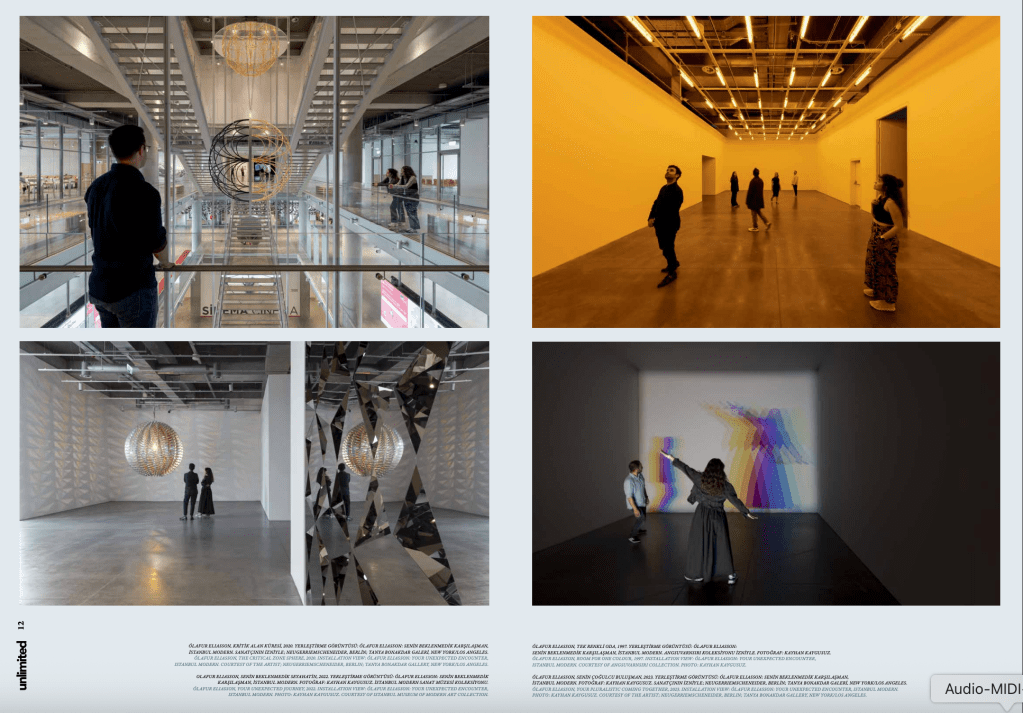
When entering the place, one of the first things we notice is the colored glass panels placed on a wood piece. Dusk to dawn, Bosphorus (2024) vividly represents his thoughts on the city. The unique location of the Istanbul Modern Museum near the Bosphorus inspired Eliasson in some of his works designed explicitly for Istanbul. The artist’s color experiments and circular painting series also give us a glimpse of the geometric forms that will be consistent throughout the entire exhibition. One of the large-scale installations, Less ego wall (2015), is an immersive process of self-reflection. Designed with steeled pyramid-shaped mirrors and triangular openings in between, this versatile installation offers a space to consider the relationship between self and the other while seeing one’s reflection in the mirror and others’ movement through the gaps. Viewing from different angles allows us to engage with the artwork, leaving the “I” aside.
In his artistic practice, Eliasson often explores the aspects of the climate crisis. This notion finds material form in the exhibition’s glacier-shaped sculptures, ocean-inspired paintings, driftwood pieces, and chromogenic prints. In The glacier melt series (1999/2019), he keeps a record of the same place, a landscape in Iceland, to compare it in his revisit after two decades, where we can feel the absence of glaciers and notice the detrimental effects of the climate crisis. As sentimental as it is, it is also an ecological and political exploration, redirecting our attention to the current issues. His non-dualistic approach to nature, not perceiving it as a separate entity, encourages visitors to have similar views and actions in the real world.
Another shared use of the physical space is created through the light. Your hesitant kaleidorama (2022) is a virtual encounter in which visitors gradually witness the expansion of colored light rings in the projected image. The motion and velocity of the light create an atmosphere, a process of transformation, a form of division, and a robust tactile sensation in the body. This movement almost represents the evolution of time, a reflection of the void, while bringing our senses back to the rhythms of life. The other dynamic interplay between light and form appears in the Model for a timeless garden (2011) visitors witness the water fountains only for a limited time before they entirely disappear in the dark. The work’s physical structure creates bodily tension and an opportunity to question philosophical concepts such as the absence of space and time.
The optical illusion Your pluralistic coming together (2023) consists of LED spotlights in eight different colors, creating colorful shadows on the wall. The installation shows us the extent to which the artwork wouldn’t exist without the visitor physically being in the room. Eliasson’s persistent use of the second person in the titles also creates self-directed attention, almost a brief conversation between the visitor, artwork, and the artist.
Filling the explanatory gap between the conscious mind and the physical body (2020) includes precisely positioned circular mirrors to allow visitors to perceive their beings from different angles. The mirror reflection is another introspective moment in the exhibition where the cognitive perception of ourselves is shared with other bodies. The experience is not alone, but again, shared with others, which creates a new dialogue between self and other. Are they positioned in response to reality or to introduce new ways of seeing? This self-reflection sparks intellectual curiosity and is almost a symbolic representation of Evan Thompson’s philosophy, which explores the notion of embodied cognition and our relationships with the physical body – also an influential reference for Ólafur Eliasson in his artistic practice.
The final work is the installation Room for one colour (1997) which creates a visual and conceptual experience for the visitors. The use of monochromatic lamps in the room changes the perception of colors as they appear to be in the range of grey, yellow, and black. Not only the shades but also the vision is altered as the audience starts to perceive themselves attentively. The installation evokes a prompt self-awareness as we start to observe ourselves and the environment in a different light. When the perception is altered, how we make sense of the world is also redefined, emphasizing a sense of contextual reality.
In search of the invisible
Eliasson’s visceral play with the forms brings us back to our senses as we consider new ways to contact the physical space. The structuring of the environment activates what is available to us, whether visible or invisible. As much as his previous works, the current exhibition also blurs the lines between art and design and encourages us to participate in this contemplative dialogue. Using lights and specific materials creates a territory where the artist conveys a thought, whether ecological, political, or philosophical. The immersive experience is constantly realized through geometrical shapes and architectural elements in his work, creating a perfect balance between physical and conceptual. While engaging with the artwork, we reconsider the function of design to see what is possible beyond the form and material. Eliasson shows us the transformative power of art created and recreated through each contact. Instead of being an object of consumption, art becomes a part of a collective, a shared imagination. What does this direct communication between the body and the space tell us? How do the visitors contribute to the place, the design, and the art?
The exhibition Your unexpected encounter is an immediate and continuous realization of the self, surroundings, and the other. Refusing to focus directly on the artwork, we rather question our approach, distance, and movement in relation to the shared space. The artist’s works create a new, relative reality that can only be reached through the senses. The moment we are fully present in our bodies, we can explore spatial relationships with both the physical and the imaginary.
 aysu naz atalay